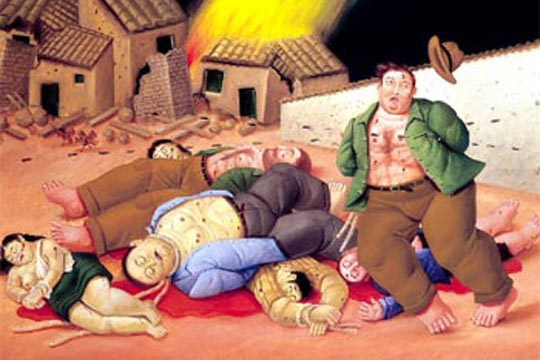
The special rapporteur of the UN to arbitrary executions, Philip Alston , reported that about 98.5% of cases of extrajudicial killings go unpunished in Colombia .
Alston made a report after visiting Colombia in June 2009. There said "the current rate of impunity for alleged killings by security forces is too high." At the same time, said "unless the Government to ensure the effective investigation and prosecution of executions committed by the military, can not overcome the scandal of false positives.
The UN official said the "members of Colombia's security forces carried out a significant number of extrajudicial executions in a pattern that was repeated across the country. "
The weight of " false positives "in the presidential election
Colombian presidential candidate Antanas Mockus expressed his horror at the so-called "false positive" mode extrajudicial execution committed by members of the security forces for prizes and free days in the counterinsurgency war in this South American country. Military battalions attracted over 30 young people through deception, were shot and dressed as guerrillas or paramilitaries to submit officially killed in action.
is a
"extreme manifestation of the culture of the shortcut, the culture of anything goes" he said Mockus
in a meeting with foreign journalists Wednesday.
fire practice in government of Alvaro Uribe
, in power since 2002, and peaked while the Ministry of Defence
was in the hands of the now-official presidential candidate Juan Manuel Santos
from July 2006 to May 2009.
The Attorney General investigates 2077 aggravated murders allegedly committed by the security forces. Of these, 274 false positives identified in 2006 and 505 in 2007. In 2008, he began the descent, with 156, and in 2009 there were at least seven cases with 16 victims.
Data Bank
prestigious Center for Research and Popular Education (Cinep) has documented 501 cases of extrajudicial court in the form of false positives, with 1,113
victims between 2001 and 2009 , but cautions that his research does not cover the whole country.

Santos is the main rival of
Mockus, polls, whose forecasts indicate there will be runoff between the two on June 20, as none will reach over half of votes necessary to devote president in elections on Sunday 30.
"I am convinced that neither the President (Uribe), and the minister (Santos) are determiners of false positives said Mockus
. In the street does not have an opinion so diplomatic.
Santos's predecessor in the portfolio Defense
then
ambassador to the Organization of American States, Camilo Ospina , was the one issued in November 2005, a secret directive that provided incentives for military success recalled
Mockus.
The candidate compared that policy with another force for the U.S. Army
during Vietnam War, which ended up producing the
My Lai massacre in March 1968 when U.S. troops killed at least 350 inhabitants of this village in southern Vietnam. The candidate, mathematician and philosopher, considered
"tragic" is that "incentive schemes
crazy actors."
"Is there a cure tragedy judging these people?" , Mockus
asked in reference to
Uribe and Santos
. What you can try is
"the eventual level of negligence in detecting and correcting" he said.
"I do not see criminal responsibility, moral responsibility to see them if you like politics," he said. Santos
adamant that, as a minister and with President Uribe
,
"denounce the problem, we decided we had to take, with transparency for the country" and defined a total of 15 measures
" were effective" against it.
In November 2007, Santos
issued a new policy that rewarded catches and demobilization of combatants. If the standard had been awarded to the officers themselves had fewer casualties and more than "
enemy", since then outweighed the decline the kidnapping and murder in the respective jurisdiction.
"Allegations of false positives dropped dramatically since November 2008 " remarks the candidate
Santos on each occasion that he has raised the issue in this campaign,
"over 100 times "he says.
But it was only in October 2008 when the government dismissed 27 officers, during a surprise visit to Colombia
of Nations High Commissioner for Human Rights, Navi Pillay.
The dismissals "were a response when they realized? Or when they realized that the world had realized? "Raised Mockus. Colombian justice would fail in its attempt to clarify the facts,
" to have competition in the international system " he said.

Impunity is what they fear 16 families of victims of false positives in the city of Soacha glued to the south of Bogotá . In the last week were released 39 military involved in these crimes. They are still 25 prisoners, including colonels and majors.
defense strategy is to delay the military trials and obtain the freedom of those involved and deadlines, while the military justice system struggles to take over the process. Mothers and widows
threatened. The brother of one victim was killed as a noncommissioned officer who reported an execution. Therefore, the Mothers of Soacha , as they are known, went on Monday, 24 a letter to Luis Moreno Ocampo , Attorney International Criminal Court (ICC).
"In these two years have operated a number of mechanisms of de facto impunity, legal, political and others that have undermined the chances of meeting a real truth, that there is justice and full reparation , "the letter and requested the intervention of the ICC .
lawyer and journalist Felipe Zuleta , author of the documentary" Poverty, a crime that is paid for death, " asked in January to Prosecutor to investigate Uribe and Santos for collusion, ie " the negligence of state officials when it comes to crimes against humanity. "Opposite the former defense minister, Zuleta considered that it is full proof." The fact that false positives have dropped to almost nothing from that " the government learned " as Zuleta thesis, " mean that a crime was controlled."
"Crime control, is one in which you give the order and stops. Crime is uncontrolled one in which the State, despite its efforts, can not do anything to stop " he said.
Mothers At the unworthy Soacha Santos is a presidential candidate. "Not because he pulled the trigger" , clarify, " because he was the chief of the Armed Forces " and "must assume responsibility ."
Colombia Garzon claimed intervention

the same day that Judge Baltasar Garzón
reached Hague in Bogotá
already claimed their presence so that, as an advisor to
International Criminal Court (ICC) , to take charge of investigations
2,270 murders of Colombian youth by soldiers, who posed by guerrillas killed in combat in order to achieve promotions and collect rewards.
Relatives of the boys killed on Monday sent
Luis Moreno Ocampo, chief prosecutor of ICC
the Soacha report: the tip of the iceberg: crime and impunity, which experts believe "
document rigorous, detailed , terrifying. "
"We came to the ICC not to find justice in Colombia. Garzón We want to investigate the crimes of the state because we have full confidence in him " he told La Vanguardia
María Sanabria, mother of a teenager 16 years was killed by soldiers while Santos
was defense minister.
"I want to see Garzón leads Saints before the ICC, is responsible for systematic killings in supporting a policy that encouraged these crimes " said Blanca Nubia Monroy
, another mother of a murdered son.
Deputy
Iván Cepeda, spokesman
National Movement of Victims of State Crimes , told La Vanguardia
the arrival of
Garzón to Colombia to investigate crimes
army "would be great confidence that it will stop impunity; familiar with the issue of youth killed by soldiers and says that these crimes must be investigated " .
Cepeda stressed that Colombians are hoping that the Garzón
first job as adviser TPI investigate the be justice and peace law giving impunity to paramilitary and military crimes.
"Garzon came to Colombia as a judge several times, met with NGOs and victims' families," says Cepeda
.
analyst Felipe Zuleta Garzón stresses that knows the reality of Colombia
, a country he has visited frequently. "It is very important
-stressed-
that as a consultant is connected to the ICC, and has jurisdiction over these crimes because the victims no English."
The UN criticizes social situation in Colombia

A specialized agency of the UN
transmitted to the Government of Colombia judgments of disapproval by poor South American country's social conditions and instructed to take corrections for improvement.
In its comments on the Colombian case, the
Committee on Economic, Social and Cultural Rights UN of
said he was "deeply alarmed
" episodes of violence, injustice and inequality that affect marginalized and vulnerable populations in Colombia
.
This country of some 44 million inhabitants, has 27.7 percent of its population with unmet basic needs . over 40 percent of households food insecure and more than 20 percent of under five malnutrition support, says the shadow report civil society, citing official data. The unemployment is nearly 12 percent , well above the South American average of eight percent.
The recommendations of the UN Committee refer to some very interesting points, such as ways to treat victims of armed conflict, Colombia lives since 1964 and the internal displacement, but those issues do not appear on the electoral debate said the specialist. " Candidates will be questioned on these points " he said.
The Committee opened an extensive list of counterclaims to the Colombian government a declaration of "alarm deep "in the aftermath of protracted internal conflict and its impact on affected populations..
Since the first observation, the Committee expresses particular concern about the consequences of violations of rights in the most vulnerable: indigenous peoples Afro-Colombians, women, children, some four million internally displaced and poor peasants.
UN experts were also concerned by the large infrastructure projects, mining development and promotes the Colombian state without the consent, prior and informed consent of affected communities, indigenous and Afro-Colombian.
The Committee also objected to government policy to encourage export production, such as biofuels, as they may deprive the peasants of their land.
On this point, the Committee expressed alarm over the killings of union leaders in Colombia and other forms of threats and violence against labor leaders.
One of the experts of the Committee wondered, listening to the descriptions of poverty, unemployment and malnutrition of marginalized Colombians, if that South American country "is a nation state defends the public or there is a government defending a particular class. "
(Sources: Agencia IPS, La Vanguardia, Barcelona and PULSAR Agency)